




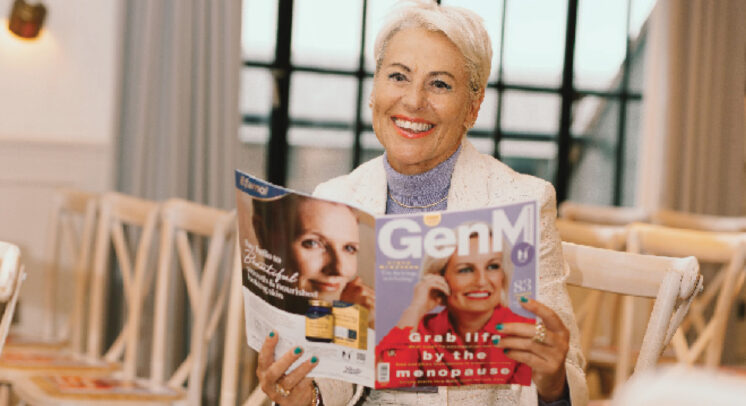
UK-BASED organisation GenM founder Heather Jackson (pictured) is on a mission to support pharmacies helping women through menopause with its MTick certification and accreditation.
Earlier this year, GenM made its Australian debut through its partnership with TerryWhite, when the pharmacy business launched its focus on women's health (PD 16 Feb), and intends to engage with other retailers across the country.
For Australian brands, retailers and shoppers unfamiliar with the scheme, products displaying the symbol must undergo rigorous testing and criteria assessment verified via clinical user trials and expert validation, to prove that their products can help support one or more of the many recognised signs of menopause.
Jackson told Pharmacy Daily she was inspired to start the enterprise when she went through perimenopause and struggled to find the products she needed to support the symptoms she was experiencing.
"I was shopping for products that would help me have a better lived experience, from climate-controlled bedding to foundation that wouldn't run down my face to the supplements that I might need for my night sweats or my anxiety or my thinning hair," Jackson said.
After commissioning research on the experiences of women undergoing perimenopause and menopause, she said it became clear that many felt overlooked and let down by brands they had been loyal to throughout their lives.
What they wanted, Jackson said, was 'a one-stop shop for menopause', giving rise to the idea for a clearly identifiable symbol certifying menopause-friendly products that lived up to their claims - hence GenM and its MTick certification scheme.
"Since 2019 when it started, GenM has united over 100 of the most recognised and powerful brands and retailers to partner with GenM and commit to making menopause more visible," Jackson said.
In Australia, this includes products from 11 brands - Promensil, Centrum, Femfresh, Mitchum, Boost Lab, BioGaia, Dulcolax, MY Pause, Happy Healthy You, NuAllume, and Hey Sister.
While seen by many as a positive in terms of breaking down stigma and taboo, the increased conversation around menopause over the last few years has also piqued the interest of brands looking to exploit this potentially lucrative but vulnerable market.
This has led to some fairly dubious tactics, dubbed 'menowashing', where a standard product is branded with the word 'meno', and marketed for menopause symptoms without solid scientific evidence.
Examples include personal care products, supplements, and famously, chocolate.
Holland & Barrett found itself under scrutiny from the UK advertising standards authority in 2024 around claims one of its chocolate bars helped soothe some symptoms of menopause.
While acknowledging it as an issue, Jackson declined to be drawn on some of the more egregious examples of menowashing, although she did highlight concerns about supplements.
"I was a naive consumer, and I have to say, I thought that all supplements that sat on a shelf did what they said on the label," she told PD.
"Obviously I've done my research now, and not all supplements are equal - when you turn the bottle around, you realise they haven't got enough of a given ingredient to actually do what they say."
Jackson explained that MTick certification for supplements specifies minimum inclusion levels of key nutrients, and GenM conducts post-manufacturing tests to ensure label claim compliance.
"What's really exciting is that many of those products that had initially failed went back to the scientists, back into production, and had more ingredients put in there for all the right reasons," Jackson enthused.
"We do believe that over the next 18 months, the MTick will be seen as the symbol of symbols and certification of certifications - that we really are challenging on all levels and actually doing what women need.
"Navigating the trusted menopause market is made easier with the MTick, delivering shoppers the symbol they need to make informed shopping choices and help them to live their best menopause - as I wanted to do," Jackson concluded. KB
The above article was sent to subscribers in Pharmacy Daily's issue from 21 Apr 26
To see the full newsletter, see the embedded issue below or CLICK HERE to download Pharmacy Daily from 21 Apr 26